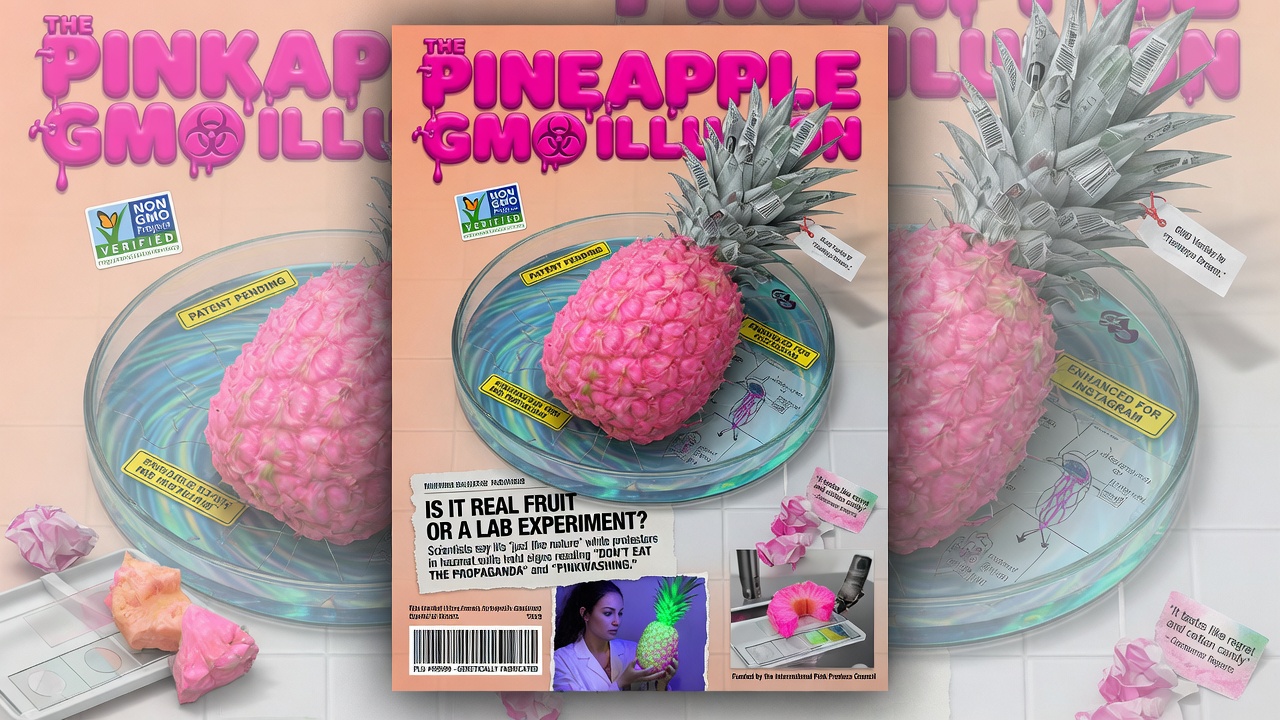
In an era where trust in our food system is already fragile, the arrival of Del Monte’s Pinkglow pineapple represents everything wrong with genetically engineered organisms. This isn’t just another novelty fruit. It is a vivid symbol of corporate power overriding natural integrity, all while hiding behind a suspiciously thin veil of “safety” testing.
For decades, organic advocates have warned that GMOs bypass the careful, time-tested rhythms of traditional breeding. The pink pineapple makes that warning impossible to ignore. By silencing specific genes through RNA interference, scientists forced the fruit to accumulate lycopene, turning its flesh an unnatural bubblegum pink.
What should have been a cautious, transparent process instead became another closed-door corporate project.What makes this case particularly disturbing is who performed the safety testing. Del Monte, the very company set to profit handsomely from this engineered pineapple, supplied all the primary data. They designed the studies, ran the analyses, interpreted the results, and handed them to regulators. No fully independent, long-term, third-party verification was required. This is not science. This is marketing dressed up as science.
Think about that for a moment. If a pharmaceutical company tested its own drug and simply told the FDA “trust us,” the public would rightly revolt. Yet with our food — something we consume daily — we accept this model. The FDA’s voluntary consultation process for the pink pineapple essentially boiled down to reviewing Del Monte’s own homework. No mandatory independent lab replication. No long-term multi-generational human studies. Just a company conclusion that their creation is “substantially equivalent” to real pineapple.
Why It’s Seen as Suspicious
- Del Monte conducted the safety studies, compositional analyses, and other assessments for the pink pineapple. They submitted that package to the FDA.
- The FDA’s process is a voluntary consultation — not a full pre-market approval requiring independent testing. FDA scientists review what the company provides, can ask for more information, and issue a “no unresolved safety questions” letter. They don’t typically run their own parallel studies or commission fully independent labs for every new GM product.
- This creates a clear conflict of interest: the company with the strongest financial incentive to get the product to market is also the primary source of the safety data.
Critics argue this system lacks the rigor of, say, pharmaceutical approvals (which require more independent oversight and phased clinical trials). Anti-GMO groups and organic advocates often call it a “rubber stamp” process. Similar concerns apply across many GM crops — the developer funds and largely controls the studies.
This conflict of interest should raise red flags for every conscious consumer. Companies have powerful financial incentives to downplay risks, minimize testing costs, and push products to market quickly. History is littered with examples where industry-funded research later proved overly optimistic or outright misleading. Why should GM pineapples be any different?
Organic farming operates on an entirely different philosophy. It respects natural genetic variation, uses time-honored selective breeding, and maintains the wholeness of the plant and soil. Genetic engineering, by contrast, treats the genome like editable software. In the pink pineapple, genes were suppressed using constructs that many organic consumers view as invasive and unpredictable.
Critics rightly ask: What are the long-term consequences of eating fruits whose internal biochemistry has been artificially rewired? Even if no immediate toxin appears in 90-day rodent studies, subtle effects over years or across generations remain largely unexamined. The burden of proof should fall on the introducers of this technology, not on consumers to prove harm after the fact.
The precautionary principle — central to organic values — has been largely abandoned in American GMO policy. Europe has taken a far more cautious approach, often requiring stronger independent evidence. In the U.S., innovation and corporate convenience seem to take priority over consumer peace of mind.
Furthermore, the pink pineapple highlights the creeping corporate control of our food supply. Patented GM varieties tie farmers and ultimately consumers to large agribusinesses. Seeds (or in this case, planting material) become intellectual property rather than the common heritage of humanity. This undermines the independence that organic growers cherish.
Even the marketing of the pink pineapple feels manipulative. Bright pink flesh is pushed as fun and Instagram-worthy, distracting from the deeper questions about genetic manipulation. It turns food into a novelty product rather than nourishing sustenance grown in harmony with nature.
Many independent scientists and researchers have expressed discomfort with the limited oversight. Calls for truly independent, publicly funded research on GMOs are routinely underfunded or ignored. The same companies that profit from these crops often wield significant influence in research institutions and regulatory bodies.
Consumers deserve better. We deserve mandatory, clear labeling of all bioengineered foods so that those who choose organic and non-GMO can easily avoid them. We deserve testing protocols that remove the fox from guarding the henhouse. Until that happens, suspicion is not only reasonable — it is responsible.
The creation of the pink pineapple began around 2005 in Del Monte’s laboratories. Using genetic engineering tools, they targeted enzymes that normally convert pink lycopene into yellow pigments. By suppressing those enzymes, they created a plant that stores more lycopene. Elegant on paper, perhaps. But executed within a system lacking true independent safeguards.
Supporters claim higher lycopene is beneficial. Organic advocates counter that we should obtain antioxidants through diverse, naturally grown foods rather than engineered monoculture products grown with industrial methods. Nature already provides plenty of lycopene in tomatoes, watermelon, and guava without genetic shortcuts.
This fruit also represents a troubling precedent. If we accept self-tested GM pineapples today, what comes next? GM versions of more staple crops with increasingly complex modifications? Each step further entrenches a system that many see as fundamentally at odds with organic principles of purity and ecological balance.
Public skepticism toward GMOs remains high for good reason. When the developer and the tester are the same entity, trust evaporates. The pink pineapple may look pretty on a plate, but for those committed to organic living, it serves as a bright pink warning sign about where our food system is heading.
Organic advocates continue to push for genuine transparency, stricter regulations, and support for truly natural farming methods. Until meaningful reform occurs — including mandatory independent, long-term safety testing funded outside of industry — caution and avoidance remain the wisest path for health-conscious families.
The story of the pink pineapple is not really about color. It is about control, transparency, and whether corporations should be trusted to police themselves when it comes to the genetic future of our food. For this organic advocate, the answer is clear: they should not.
Genetic Roulette: The Documented Health Risks of Genetically Engineered Foods:
This book, prepared in with input by more than 30 scientists, is for anyone wanting to understand GM technology, to learn how to protect themselves, or to share their concerns with others. It is presented in the clear, accessible style that made Jeffrey Smith’s Seeds of Deception the world’s best-selling book on genetically engineered foods.

 Google’s 32 Million Mosquito Experiment: Biotech Breakthrough or Backyard Gamble?
 Blood Sugar Stability the Organic Way: Low-Glycemic Foods and Meal Ideas
 How to Build a Fully Organic Pantry on a Budget: Essentials for Beginners
 10 Nutrient-Dense Organic Foods to Boost Your Energy Without Caffeine