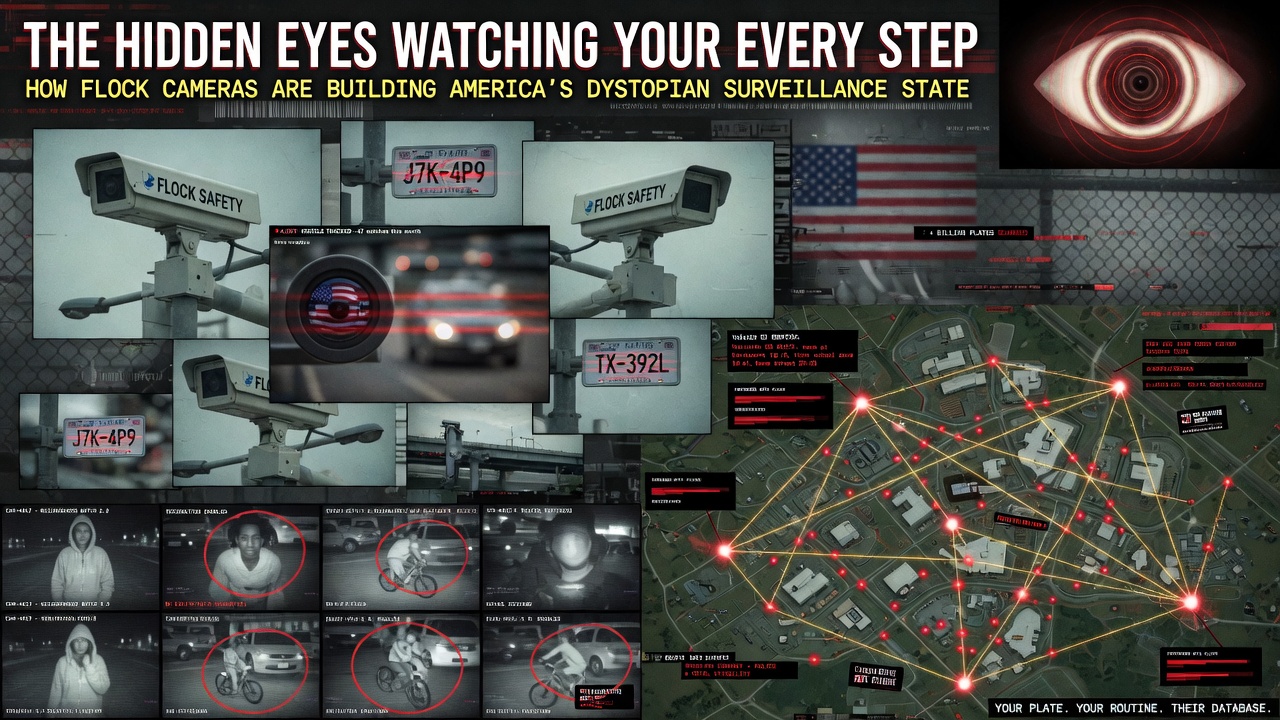
Flock Safety cameras are spreading rapidly across American cities and suburbs. Many drivers assume these devices only log license plates of passing vehicles. This assumption is dangerously wrong. Pedestrian tracking capabilities have quietly expanded the net far beyond roads.
These systems use advanced AI and high-resolution imaging to identify and follow individuals on foot. Facial recognition elements combined with gait analysis create persistent digital profiles. Citizens walking to work or shopping can be tracked block after block. The illusion of anonymity in public spaces is rapidly vanishing.
Law enforcement agencies praise Flock for solving crimes and enhancing safety. Yet the constant data collection raises profound constitutional questions. Billions of data points flow into private and government databases daily. Once created, these profiles prove difficult to delete or control.
The popular TV series Person of Interest depicted a machine that predicted crimes through total surveillance. Vigilante heroes fought to protect individuals from an all-seeing system. Today’s reality mirrors that fiction more closely than many admit. Technology once imagined as futuristic entertainment now operates in neighborhoods nationwide.
Flock cameras do not merely record passing cars as advertised. Integrated software identifies people by clothing, body shape, and movement patterns. Cross-referencing with other surveillance feeds builds comprehensive movement histories. Walking down a sidewalk now leaves a traceable digital trail.
Privacy advocates warn that such systems erode Fourth Amendment protections. Warrants are often unnecessary when data comes from private companies. Partnerships between tech firms and police blur the line between public safety and mass surveillance. The result is a de facto national tracking network.
Imagine heading to a protest or visiting a sensitive medical clinic. Your path could be mapped and stored indefinitely. Authorities or third parties might access this data without your knowledge. The chilling effect on free movement and association grows stronger each year.
Person of Interest explored the moral corruption possible when immense power meets advanced algorithms. In the show, the machine’s creators faced temptation to abuse its capabilities. Real-world surveillance tools present identical ethical hazards. History shows how monitoring technologies often expand beyond initial justifications.
Flock’s own documentation and user reports confirm pedestrian detection features. AI models trained on vast video datasets improve recognition accuracy over time. Even partial facial obscuration rarely defeats the system entirely. Citizens are being cataloged whether they realize it or not.
Small towns and rural areas are adopting these cameras alongside major metros. The surveillance web expands beyond urban centers into previously private spaces. Local governments often receive grants that encourage rapid deployment. Few residents receive meaningful notice or opportunities to opt out.
People keep saying Flock only tracks vehicles. Wrong. These cameras follow you on foot too.
— Jason Bassler (@JasonBassler1) June 10, 2026
Don’t take my word for it… watch this 👇 pic.twitter.com/ysOZKi98k7
The dual nature of technology appears clearly in these developments. Tools that help recover stolen vehicles or locate missing persons also enable authoritarian overreach. Protecting society from crime must not require sacrificing fundamental liberties. Balance remains essential yet increasingly elusive.
Critics compare the current trajectory to China’s extensive social credit and camera systems. While the U.S. context differs, the technological foundation is strikingly similar. Private companies profit handsomely from selling surveillance as a service. Democratic oversight struggles to keep pace with innovation speed.
Data security concerns compound the privacy issues. Breaches or insider misuse could expose sensitive location histories to criminals or foreign actors. Once information exists in these databases, perfect security proves nearly impossible. The risks extend far beyond simple traffic enforcement.
In Person of Interest, characters fought both the machine and those who sought to weaponize it. Real Americans may soon need similar vigilance against unchecked surveillance creep. Public awareness and legislative action offer potential counterweights. Complacency invites permanent loss of personal autonomy.
Communities have begun pushing back through local ordinances and lawsuits. Some cities have limited camera placements or data retention periods. These efforts remain fragmented against powerful industry and law enforcement alliances. Coordinated national conversation is urgently needed.
Flock representatives emphasize public safety benefits and targeted usage. Yet marketing materials and technical specifications reveal broader capabilities. Transparency gaps persist regarding data sharing and long-term storage practices. Citizens deserve clearer answers about who accesses their movements.
The show’s central question resonates today: who watches the watchers? Without strong safeguards, surveillance tools risk serving political or corporate interests. Predictive policing algorithms may inherit existing biases or create new ones. Future abuses could target specific groups or individuals.

Everyday activities like jogging, meeting friends, or attending religious services now generate permanent records. The cumulative effect undermines the freedom that defines American life. Reclaiming privacy requires understanding these systems fully. Ignorance serves only those who benefit from control.
Technological progress offers genuine opportunities to enhance security and convenience. Responsible deployment demands clear rules, independent audits, and citizen consent mechanisms. Innovation should serve humanity rather than dominate it. The choice between protection and oppression remains ours to make.
Expanding Flock networks coincide with other surveillance trends including facial recognition in airports and smart city sensors. The combined infrastructure creates an unprecedented observation capability. Science fiction warnings have become policy debates. The window for meaningful intervention is narrowing.
Person of Interest ultimately highlighted human resilience against machine dominance. Individuals refused to surrender agency despite overwhelming odds. Americans can still demand accountability from both government and private tech companies. The power to shape this future has not yet been fully lost.
Communities should research local camera deployments and data policies immediately. Supporting organizations focused on digital rights can amplify individual voices. Voting for representatives who prioritize privacy protections matters more than ever. Small actions today prevent larger erosions tomorrow.
The surveillance state advances one camera at a time, one database at a time. Recognizing pedestrian tracking as a core Flock function is essential for informed debate. Technology’s promise to protect must never eclipse its potential to enslave. Eternal vigilance remains the price of liberty in the digital age.
“We Hacked Flock Safety Cameras in under 30 Seconds” by Benn Jordan
This is the standout video. It’s deeply investigative, technically detailed, and directly addresses pedestrian tracking, vulnerabilities, questionable efficacy, and pushback against the system. It’s long-form, well-produced, and has sparked real community action. Perfect match for your article’s tone on Flock going beyond vehicles.
Do Faraday Cages work???
A Faraday cage is an enclosure made of conductive material — such as metal mesh, wire, foil, or specialized fabric — that blocks external electromagnetic fields and radio frequency signals from penetrating inside.It works on the principle of electromagnetic induction: when an external electric field hits the conductive surface, it causes electrons in the material to rearrange and cancel out the field within the enclosed space. As a result, devices like phones, GPS trackers, RFID cards, or key fobs inside a properly sealed Faraday cage lose all cellular, WiFi, Bluetooth, and GPS signals, effectively making them invisible to wireless tracking networks. This simple but powerful physics concept, discovered by Michael Faraday in the 1830s, is now widely used in privacy tools like signal-blocking bags to prevent remote surveillance and data interception.
Yes, Faraday cages (and Faraday bags/pouches) work very effectively for blocking radio frequency (RF) signals — but they have clear limitations depending on what you’re trying to evade. What They Block WellFaraday cages block electromagnetic waves by redistributing them around the conductive enclosure (metal mesh, foil, or specialized fabric with conductive layers). Quality ones reliably stop:
- Cellular signals (4G/5G calls, SMS, data)
- GPS tracking
- WiFi and Bluetooth
- RFID and NFC (e.g., contactless cards, key fobs)
- Remote hacking or pinging of your devices
Real-world tests (including independent ones) show good bags achieve 60–100+ dB attenuation across common frequencies when properly sealed. Your phone inside one typically loses all signal — no calls, no location services, no “Find My” pings. What They Don’t Block
- Visual surveillance — Cameras (including Flock’s pedestrian tracking via video/AI/gait analysis) see right through them. No help against facial recognition or physical cameras.
- Extremely low-frequency fields (e.g., Earth’s magnetic field)
- Signals if the cage isn’t fully sealed — Even small gaps or poor closures let signals leak.
- All frequencies equally — Performance drops at very high frequencies or with low-quality/cheap bags.
- Active transmitters that overpower the shielding (rare for consumer devices).
Practical Use for Privacy/Surveillance Evasion
- Put your phone in a Faraday bag when you want to go “dark” (stops network-based tracking).
- Use for car key fobs to prevent relay attacks.
- Great for RFID blocking (wallets, passports).
- Combine with earlier tips (hats, sunglasses, route planning) for layered defense against camera-heavy systems like Flock.
Quality matters — Mission Darkness, SLNT, GoDark, and similar tested brands perform consistently. Cheap Amazon no-names or foil chip bags are hit-or-miss. Test yours by trying to call the phone inside the sealed bag.In the context of the surveillance state discussion: Faraday tools are excellent against wireless tracking but won’t hide you from the visual AI camera networks spreading across the U.S. They’re one tool in a broader privacy strategy.
Click on the pictures below to view and purchase high-quality Faraday bags and anti-surveillance gear.
These recommended products are tested for effective signal blocking and can help you protect your privacy while navigating an increasingly monitored world.
 GM Crops – Farmer To Farmer (video)
 Fantastic Fungi documentary Film
 World’s Largest Study to Determine Effects of Gmo and Pesticides on Human Health