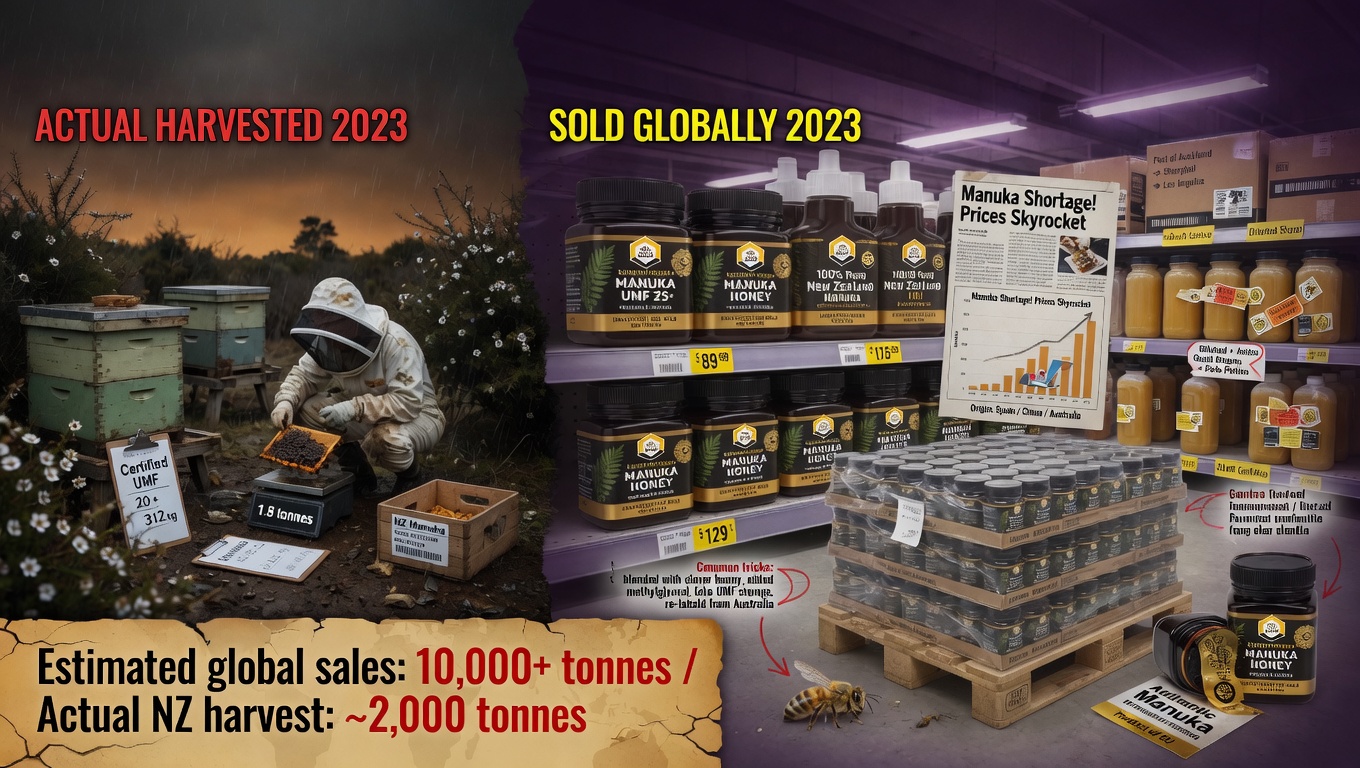
The global fascination with Manuka honey has transformed it from a niche New Zealand product into a worldwide wellness phenomenon. Prized for its unique antibacterial properties and potential health benefits, Manuka honey commands premium prices that have attracted both legitimate producers and opportunistic fraudsters.
Demand for authentic Manuka honey far exceeds supply. New Zealand produces roughly 1,700 to 10,000 tonnes annually depending on seasonal yields, yet global sales labeled as Manuka often reach 5 to 10 times that volume.
This enormous discrepancy reveals a troubling reality in the honey market. The limited natural supply simply cannot satisfy the explosive international appetite for this golden elixir.
Counterfeiters have capitalized on the premium pricing and perceived health halo surrounding genuine Manuka honey. Many products flooding store shelves and online platforms bear the Manuka name but contain little to none of the real thing.
Common fraud tactics include diluting authentic Manuka with cheaper honeys, mislabeling regular honey varieties, or creating entirely synthetic batches designed to mimic the appearance and basic chemistry of true Manuka.These deceptive practices undermine consumer trust and threaten the reputation of New Zealand’s beekeeping industry. Honest producers struggle to compete when fake products sell at similar or even lower prices.
Consumers ultimately bear the greatest risk when purchasing Manuka honey. Without proper verification, buyers may receive products that offer minimal or zero bioactive benefits despite paying top dollar.
Adulterated or fake Manuka honey lacks the distinctive compounds like methylglyoxal (MGO) that give authentic Manuka its therapeutic edge. People seeking specific health support may find their expectations unmet.
The absence of regulation in many markets makes it easier for fraudulent products to reach consumers. This situation highlights the urgent need for greater awareness and stricter industry standards.
Always seek independently tested and licensed brands when buying Manuka honey. Verifiable certifications provide the best defense against counterfeit products in today’s marketplace.
The UMF Honey Association stands as one of the most recognized authorities for authenticating Manuka honey. Their testing protocols help ensure products meet strict criteria for genuineness and potency.
Certification confirms that the honey originates from New Zealand Manuka sources and contains the minimum required levels of key bioactive markers. This rigorous process protects consumers from ineffective alternatives.
Reputable suppliers maintain detailed batch traceability systems. These records allow customers to verify the complete journey of their honey from hive to jar.
Investing in certified Manuka honey ensures access to the genuine bioactive benefits supported by scientific research. The unique properties of authentic Manuka set it apart from ordinary honey varieties.
When selecting Manuka honey, pay close attention to grading systems. Higher ratings indicate greater concentrations of beneficial compounds and stronger potential effects.
For general wellness support, look for grades such as UMF 10+ or MGO 400+. These levels provide a good balance of quality and value for daily use.
Therapeutic applications typically call for stronger varieties like UMF 15+ or higher. These premium grades contain more potent levels of active compounds for targeted health needs.
Proper storage plays an important role in preserving Manuka honey’s beneficial properties. Keep jars at room temperature away from direct sunlight and heat sources.
Avoid refrigerating Manuka honey as cold temperatures can cause crystallization that affects texture without necessarily harming quality. Room temperature storage maintains optimal consistency.
The Manuka honey industry continues facing challenges from its own success. Growing global awareness has driven demand beyond sustainable production capacity.
New Zealand beekeepers work diligently to expand Manuka forests and improve yields, but natural limitations prevent rapid supply increases. Environmental factors also influence annual harvests.
Consumers can support ethical practices by choosing verified sources. This approach helps sustain legitimate producers while discouraging fraudulent operations.
Education remains essential for navigating the complex Manuka honey market. Understanding certification marks and grading systems empowers better purchasing decisions.
The future of authentic Manuka honey depends on collective vigilance from consumers, regulators, and industry stakeholders. Greater transparency will benefit everyone invested in this remarkable product.
By demanding verifiable quality, buyers can help preserve the integrity of true Manuka honey. This ensures the product retains its well-deserved reputation for excellence and efficacy.
In conclusion, while the popularity of Manuka honey brings welcome attention to New Zealand’s natural treasures, it also creates opportunities for deception. Staying informed and choosing certified products remains the smartest way to experience the real benefits of this extraordinary honey.
Top Rated Certified Manuka Honey on Amazon (2026)
Here are the current highest-rated and best-selling certified Manuka honeys on Amazon. These are UMF or MGO certified, ensuring authenticity from New Zealand with independent testing:
1. New Zealand Honey Co. Raw Manuka Honey UMF 15+ / MGO 514+ (8.8 oz)
- One of the top performers with excellent ratings (typically 4.7+ stars).
- UMF certified for purity and potency.
- Highly praised for rich flavor, thickness, and effectiveness. Strong sales volume.
2. Manuka Health UMF 13+ / MGO 400+ Manuka Honey (8.8 oz / 250g)
- Very popular with thousands of reviews (often 4.6+ stars and 30,000+ ratings).
- Trusted brand with consistent quality and good value for daily use.
- Frequently appears in Amazon’s Choice and best-seller lists.
3. Kiva Raw Manuka Honey UMF 20+ / MGO 850+ (8.8 oz)
- Premium high-potency option with outstanding ratings.
- UMF certified, non-GMO, and traceable.
- Ideal for therapeutic use; loved for strength and purity.
4. Manukora Raw Manuka Honey (MGO 50+ to 850+ variants)
- Massive review volume (often 20,000+ reviews) with 4.6+ star averages.
- 3rd-party tested, glyphosate-free, and traceable from hive-to-hand.
- Great entry-level certified option with strong sales.
5. Wedderspoon Raw Manuka Honey (MGO 150+ or KFactor versions)
- Solid 4.7-star ratings with high review counts (20,000+ on popular sizes).
- Non-GMO and well-established brand.
Other Strong Certified Contenders:
- Comvita UMF-rated Manuka Honey (reliable high-volume brand with good traceability).
- Manuka Doctor MGO 525+ or higher (certified and popular).
Key Tips for Buying Certified Manuka on Amazon:
- Look for UMF certified (Unique Manuka Factor) or clear MGO ratings on the label.
- Prefer products labeled “Monofloral New Zealand Manuka Honey.”
- Check for batch numbers and traceability.
- Higher ratings: UMF 10+/MGO 263+ for general wellness; UMF 15+/MGO 514+ or above for stronger benefits.
- Read recent reviews and verify the seller is reputable to avoid counterfeits.
Prices typically range from $20–$50 for 8.8 oz depending on strength, with higher UMF/MGO costing more.
 Unlock the Queen Bee Secret: How Royal Jelly’s Cutting-Edge Science Could Transform Your Health and Vitality – And Why You Should Consider Adding It to Your Routine Today
 Honey as an antibiotic: Scientists identify a secret ingredient in honey that kills bacteria
 Manuka honey could help clear deadly drug-resistant lung infection
 Honey offers new approach to fighting antibiotic resistance