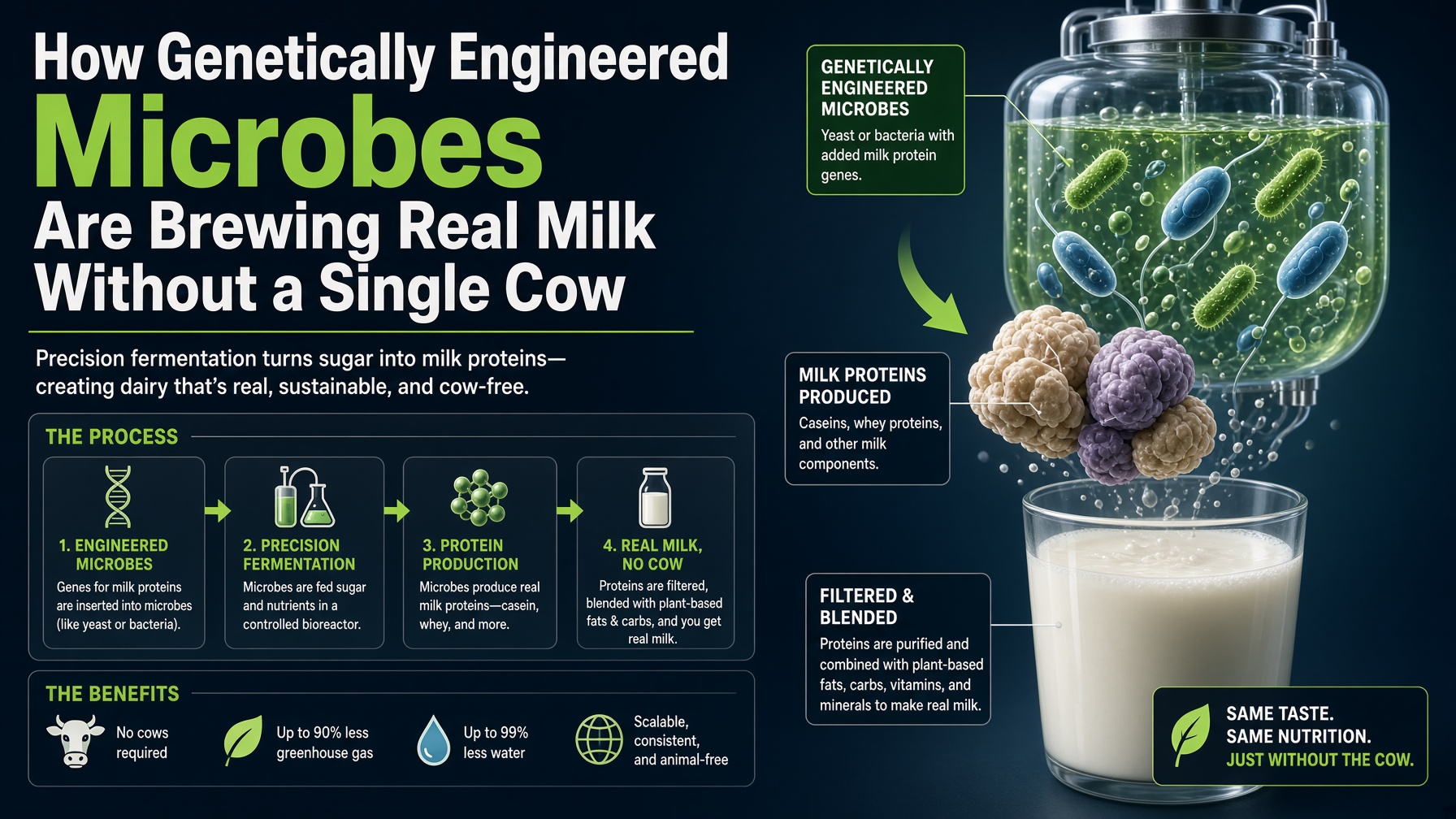
Precision fermentation is transforming dairy production by using genetically engineered fungus to create milk proteins identical to those from cows. Companies insert bovine DNA sequences into microbes such as Trichoderma reesei so the fungus produces whey proteins like beta-lactoglobulin when fed plant sugars in large bioreactors. The resulting protein is filtered purified and dried into a powder that functions exactly like traditional dairy protein in recipes. This process eliminates the need for animals while delivering the same taste texture and nutrition consumers expect. Products made this way are already appearing on store shelves across the United States and beyond.
Perfect Day pioneered this technology after its founders sought a way to enjoy dairy without ethical or environmental costs. They selected the filamentous fungus Trichoderma reesei known for its efficient protein secretion in industrial enzyme production. Once engineered the fungus multiplies rapidly in controlled tanks converting simple carbohydrates into high quality milk protein. After fermentation the biomass is removed leaving behind pure animal free whey. This ingredient has received FDA GRAS status allowing its use in a wide range of foods.
Bored Cow stands out as one of the most recognizable brands using this fungus derived protein in its animal free milks. Available in original chocolate vanilla and strawberry flavors the product offers eight grams of complete protein per serving along with calcium vitamin D and B12. Shoppers can find it in major retailers including Target and Sprouts across all fifty states. The milk froths steams and cooks much like conventional dairy yet contains no lactose cholesterol hormones or antibiotics. Consumers report that it delivers a creamy mouthfeel missing from many plant based alternatives.
Ice cream makers have embraced the technology with brands such as Breyers Nick’s and Graeter’s incorporating the protein into frozen desserts. Unilever’s Breyers launched a lactose free chocolate variety that maintains the classic creamy texture while reducing environmental impact. These products melt scoop and taste like traditional ice cream because the underlying protein structure matches bovine whey. Sports nutrition companies have also adopted it for powders and ready to drink shots including lines from Myprotein Brickhouse Nutrition and K Tropix. The higher branched chain amino acid content appeals to athletes seeking performance benefits without animal sourcing.
Larger corporations have experimented with the ingredient in limited releases and pilots. Nestlé tested Cowabunga milk drinks while Mars introduced a chocolate bar called CO2COA featuring the animal free protein. Cream cheese brands like Modern Kitchen and partnerships with Bel Group have produced spreadable options that perform like dairy counterparts. Some earlier consumer brands such as Brave Robot and Coolhaus launched ice creams before Perfect Day shifted toward a pure B2B model. Availability fluctuates as the company focuses on scaling production through facilities including a major plant in India.
Environmental advantages form a core selling point of fungus based milk proteins. Independent life cycle assessments claim reductions of up to ninety seven percent in greenhouse gas emissions compared with conventional whey. Water use drops dramatically often by ninety six to ninety nine percent while land requirements shrink significantly. The process relies on plant sugars rather than feed crops and grazing land associated with cattle. Proponents argue this approach can help meet rising global protein demand with far lower planetary impact.
Critics raise questions about the final composition of commercial products. A 2026 multi omics study found that one widely sold synbio milk contained mostly residual fungal proteins rather than the high percentage of pure beta lactoglobulin claimed by developers. Researchers also detected dozens of uncharacterized fungal metabolites whose long term safety remains incompletely studied. Lawsuits have challenged labeling practices arguing that marketing as identical milk protein may mislead consumers. Producers counter that purification removes host material and that the fungus has a decades long record of safe use in food enzymes.
The production process itself follows a clear sequence that resembles industrial brewing more than farming. Scientists first identify and synthesize the exact gene coding for the desired milk protein. That DNA is inserted into the fungal genome at precise locations so the microbe treats it as its own instruction set. Under optimized temperature pH and nutrient conditions the fungus secretes the protein into the surrounding broth. Harvesting filtration and drying yield a consistent powder free from seasonal or geographic variations that affect traditional dairy.
Other companies are advancing similar fungal platforms beyond Perfect Day. ImaginDairy uses koji mold and related fungi to produce whey and casein proteins and has secured regulatory clearances in the United States and Israel. Partnerships with firms such as Strauss Group and Danone aim to bring additional cow free cheeses yogurts and milks to market. Academic researchers continue optimizing strains for higher yields lower costs and growth on agricultural residues or even grass. These efforts expand the toolkit for creating full spectrum dairy functionality without animals.
Looking ahead fungus engineered milk proteins are positioned as a complementary option rather than an immediate replacement for conventional dairy. Scaling production capacity remains essential for broader price parity and widespread adoption. Consumer acceptance will depend on transparent labeling consistent quality and continued safety validation. As more brands incorporate the ingredient shoppers gain new choices that balance taste nutrition ethics and environmental concerns. The quiet work of genetically engineered fungus may ultimately reshape how the world sources one of its most familiar foods.
Here are some solid YouTube videos about milk/proteins made from genetically engineered fungus
Recommended Videos
- Dairy Protein Made Without Cows (Bloomberg News, ~1.5 minutes)
Clear, concise explanation of how Perfect Day uses microflora/fungus and fermentation tanks to make real whey protein without cows.
→ https://www.youtube.com/watch?v=-XuWfDPlXmo - Can Lab-Grown Dairy Give Us A Cow-Free Future? (Insider Science / Science Insider, ~7 minutes)
Good overview of the process, Perfect Day’s lab work, DNA insertion into microflora/fungi, environmental benefits, and challenges with scaling.
→ https://www.youtube.com/watch?v=dIQLqI3Yoqk - The Protein Supply Problem No One Is Explaining | Kyle Failla from Perfect Day (Interview, longer form)
Perfect Day executive discusses their fermentation process, beta-lactoglobulin production, and why they use a microorganism (fungus) instead of cows.
→ https://www.youtube.com/watch?v=rw3Xl_jN33I - Manufacturing and applications of precision fermentation to produce microbial dairy protein
Technical but accessible talk covering companies like Perfect Day, how the technology works, and applications in milk, cheese, ice cream, etc.
→ https://www.youtube.com/watch?v=0MeWay6HivA
This groundbreaking work is the first internationally published book to examine the link between a protein in the milk we drink and a range of serious illnesses, including heart disease, Type 1 diabetes, autism, and schizophrenia.
These health problems are linked to a tiny protein fragment that is formed when we digest A1 beta-casein, a milk protein produced by many cows in the United States and northern European countries. Milk that contains A1 beta-casein is commonly known as A1 milk; milk that does not is called A2. All milk was once A2, until a genetic mutation occurred some thousands of years ago in some European cattle. A2 milk remains high in herds in much of Asia, Africa, and parts of Southern Europe. A1 milk is common in the United States, New Zealand, Australia, and Europe.
In Devil in the Milk, Keith Woodford brings together the evidence published in more than 100 scientific papers. He examines the population studies that look at the link between consumption of A1 milk and the incidence of heart disease and Type 1 diabetes; he explains the science that underpins the A1/A2 hypothesis; and he examines the research undertaken with animals and humans. The evidence is compelling: We should be switching to A2 milk.
A2 milk from selected cows is now marketed in parts of the U.S., and it is possible to convert a herd of cows producing A1 milk to cows producing A2 milk.
This is an amazing story, one that is not just about the health issues surrounding A1 milk, but also about how scientific evidence can be molded and withheld by vested interests, and how consumer choices are influenced by the interests of corporate business.
 Researchers Create A Purple Genetically Engineered Lime
 Vitamin C Works for Sepsis. Will It Work for Coronavirus?
 How catnip makes the chemical that causes cats to go crazy